
Not All Pure Epoxy Chemical Anchors Are the Same
Blog post description.
4/1/20262 min read
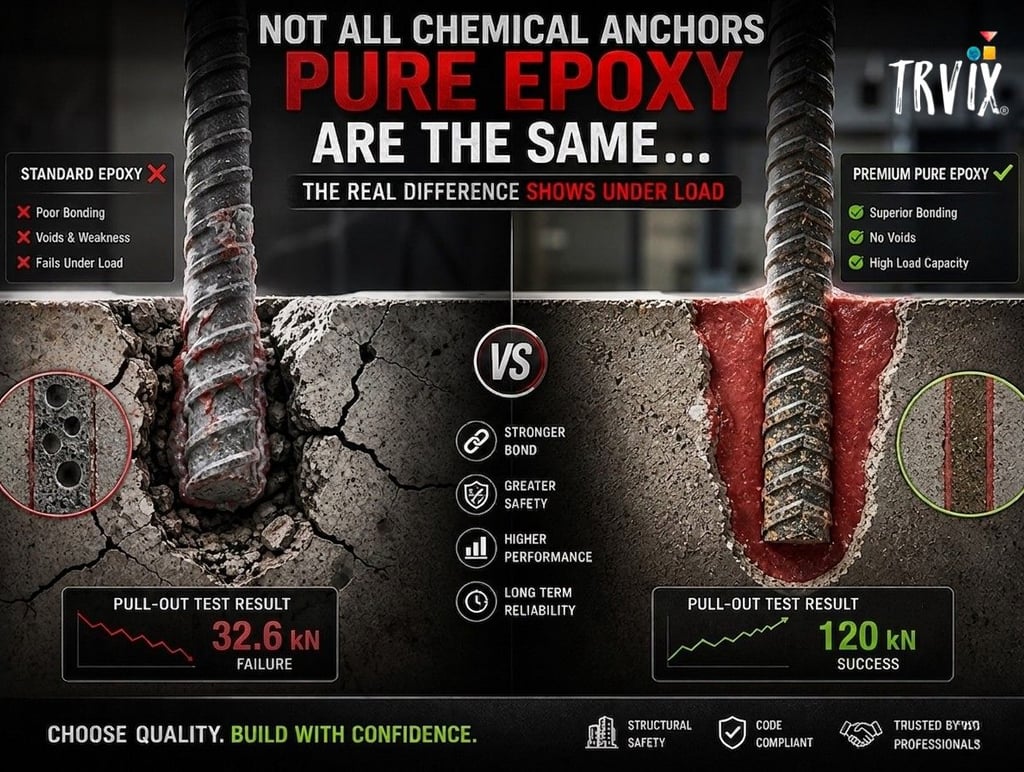
The Real Difference Appears Under Load
In the construction industry, many products look impressive on paper.
Datasheets show high bond strengths, attractive load values, and compliance claims. But when it comes to structural applications, numbers alone do not tell the full story.
The true performance of a chemical anchor is revealed under real site conditions — under sustained load, temperature variation, improper installation conditions, cracked concrete, moisture exposure, and long-term service demands.
And this is where the gap between standard epoxy systems and premium structural epoxy becomes very clear.
⸻
The Dangerous Assumption in the Market
One of the biggest mistakes in the anchoring industry is assuming that all “pure epoxy” products deliver the same level of performance.
They do not.
Two products may both be labeled as “pure epoxy,” yet their actual engineering performance can differ dramatically because of:
* Resin formulation quality
* Filler technology
* Bonding chemistry
* Viscosity control
* Crack resistance behavior
* Long-term creep performance
* Temperature resistance
* Installation tolerance
* Manufacturing consistency
* Quality control systems
In structural applications, these differences are not marketing details.
They directly affect safety.
⸻
What Actually Causes Anchor Failure?
Most anchor failures are not sudden accidents.
They are the result of weak systems hidden behind acceptable-looking specifications.
Common failure causes include:
1. Poor Bonding Performance
Weak adhesion between the adhesive and concrete or steel reduces load transfer efficiency.
This becomes critical in:
* High-load applications
* Seismic zones
* Post-installed rebar connections
* Fatigue loading conditions
⸻
2. Voids Inside the Hole
Low-quality epoxy systems may not properly wet the concrete surface or fully encapsulate the rebar.
This creates:
* Air pockets
* Incomplete bonding zones
* Stress concentrations
* Reduced pull-out resistance
The anchor may appear properly installed — until it is loaded.
⸻
3. Creep Under Sustained Load
Some epoxy systems initially perform well during short-term testing but deform over time under continuous loading.
This phenomenon, known as creep, is one of the most critical factors in structural anchoring design.
Premium epoxy systems are engineered specifically to resist long-term deformation.
⸻
4. Inconsistent Manufacturing Quality
Even a strong formula can fail if production quality is inconsistent.
Without strict process control:
* Mixing ratios vary
* Resin quality fluctuates
* Cure behavior becomes unstable
* Performance becomes unpredictable
Structural anchoring requires manufacturing discipline, not just chemical formulation.
⸻
Why Premium Structural Epoxy Matters
A true high-performance epoxy system is designed for reliability, not only strength.
The focus should be on:
* Stable long-term behavior
* Consistent installation performance
* Reliable bond in cracked concrete
* High sustained load resistance
* Controlled curing characteristics
* Tested structural behavior
* International approvals and certifications
Because structural engineers are not buying a cartridge.
They are buying confidence in load transfer and long-term safety.
⸻
Certifications Alone Are Not Enough
Many people misunderstand certifications.
A certification is important — but it is not the entire story.
Real quality depends on:
* Manufacturing standards
* Batch consistency
* Technical support
* Installer training
* Proper installation procedures
* Continuous quality monitoring
Even the best epoxy can fail if the system around it is weak.
⸻
The Industry Must Move Beyond Price-Driven Decisions
In many markets, chemical anchors are still selected mainly based on price.
This is risky thinking.
A cheaper anchor may save money initially, but structural failures, repairs, downtime, liability, and reputational damage cost far more.
The anchoring industry should evaluate products based on:
* Engineering reliability
* Verified performance
* Long-term durability
* Technical credibility
* Quality system maturity
Not simply cartridge cost.
⸻
Final Thought
In structural applications, failure rarely gives a warning.
That is why high-performance chemical anchoring is not about marketing claims or attractive datasheets.
It is about engineering integrity under real conditions.
Because when the load comes…
the truth appears.
⸻
#ChemicalAnchors
#PureEpoxy
#ConstructionChemicals
#StructuralEngineering
#PostInstalledRebar
#AnchoringSystems
#EpoxyAnchors
#StructuralSafety
#ConcreteAnchoring
#EngineeringSolutions
#CivilEngineering
#ConstructionIndustry
#ETAApproved
#ICCES
#BondStrength
#Infrastructure
#RebarConnection
#HeavyDutyAnchors
#StructuralDesign
#ConstructionMaterials
#ConcreteRepair
#EngineeringExcellence
#HighPerformanceMaterials
#TRVIX
#FixingTechnology
Contacts
Contact@Trvix.com
Socials
Subscribe to our newsletter
+201067258336